Stainless Steel vs. Cast Iron Pillow Block Bearings: Which Is Right for Your Application?
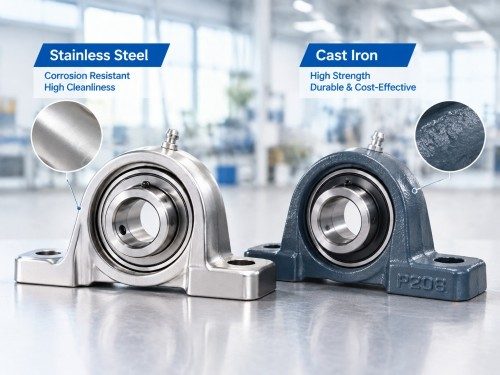
Choosing between stainless steel and cast iron pillow block bearings involves more than comparing material costs. The right choice depends on the operating environment, corrosion exposure, bearing specifications, mounting requirements, and long-term maintenance needs.
For OEMs, bearing distributors, importers, and maintenance teams, understanding these differences helps narrow down suitable configurations before requesting a quotation. This guide compares stainless steel and cast iron pillow block bearings, explains where each option may be appropriate, and outlines what to verify before purchasing.
Stainless Steel vs. Cast Iron Pillow Block Bearings: Key Differences
The main distinction is the housing material and its suitability for the operating environment. However, housing material alone does not determine the performance of a complete pillow block bearing unit.
| Selection Factor | Stainless Steel Pillow Block Bearings | Cast Iron Pillow Block Bearings |
|---|---|---|
| Corrosion resistance | Often considered for moisture-prone or corrosive environments, depending on the stainless steel grade and exposure | Depends on the cast iron material, surface protection, and maintenance |
| Typical applications | Selected washdown, food-processing, packaging, and corrosive-environment applications | General industrial machinery, conveyors, agricultural equipment, and material handling |
| Initial cost | Often higher, depending on material grade and configuration | Often economical for general industrial applications |
| Maintenance | Still requires appropriate sealing, lubrication, inspection, and cleaning | May require surface protection and maintenance to manage corrosion |
| Key purchasing checks | Material grade, internal bearing components, seals, fasteners, and lubricant | Housing protection, internal bearing specifications, seals, and lubricant |
How should you choose? Consider stainless steel when the housing must meet specific corrosion-resistance requirements. Consider cast iron when it is compatible with the operating conditions and offers a suitable balance of cost and performance. In either case, verify the complete bearing unit against the application requirements before making a final selection.
These are general guidelines rather than universal performance rankings. Actual suitability depends on the specified product and operating conditions.
When Should You Choose Stainless Steel Pillow Block Bearings?
Stainless steel pillow block bearings are worth evaluating when corrosion resistance is an important requirement. They may be suitable for equipment exposed to moisture, frequent cleaning, or certain corrosive substances, provided the selected materials are compatible with the actual environment.
Moisture-Prone or Corrosive Environments
Humidity, splashing water, and chemical exposure can affect bearing housing condition and maintenance requirements.
Before specifying a stainless steel housing, identify the substances it will contact. Chlorides, cleaning chemicals, temperature, and persistent moisture can affect corrosion performance. Select the stainless steel grade according to the actual exposure rather than relying on the material name alone.
Equipment Requiring Frequent Cleaning
Food-processing and packaging equipment may benefit from stainless steel bearing housings where corrosion resistance and cleaning requirements make them appropriate.
However, a stainless steel housing does not automatically make a complete bearing unit suitable for food-contact or hygienic applications. Verify the internal bearing materials, seals, fasteners, lubricant, cleanability, and any applicable industry requirements. For washdown applications, confirm that the sealing arrangement is appropriate for the cleaning method and pressure.
Applications Where Corrosion-Related Maintenance Matters
Where corrosion on exposed surfaces contributes to inspection, maintenance, or replacement work, stainless steel may be worth evaluating as part of a total cost assessment.
Compare purchase price, maintenance requirements, replacement accessibility, and the consequences of unplanned downtime. Stainless steel should not be assumed to eliminate corrosion or guarantee a longer service life in every environment.
Explore the stainless steel pillow block bearing range to review potentially suitable configurations. Confirm the available materials and product specifications before ordering.
When Are Cast Iron Pillow Block Bearings the Better Choice?
Cast iron pillow block bearings are commonly considered for general industrial applications where a stainless steel housing is not required by the operating environment.
General Industrial Machinery
Conveyors, material-handling equipment, agricultural machinery, and many factory systems may use cast iron bearing housings when the material, design, and protection measures meet operating requirements.
Consider moisture, dust, vibration, impact, shaft alignment, and mounting conditions. Where corrosion is a concern, verify the surface protection and maintenance requirements.
Cost-Conscious OEM and Replacement Purchasing
For OEM production and replacement programs, cast iron may be an economical option when the selected unit meets the application's technical requirements.
However, the lowest initial price does not necessarily result in the lowest total ownership cost. Compatibility, maintenance, replacement availability, and the consequences of failure should also be considered.
Existing Equipment and Replacement Requirements
When replacing an existing pillow block bearing, a compatible housing configuration can simplify procurement and installation. Still, confirm the bore, mounting dimensions, internal bearing design, locking method, and load requirements before approving a replacement.
Review the cast iron pillow block bearing range for potentially suitable options, and verify the specifications of the selected unit.
How to Select the Right Pillow Block Bearing for Your Application
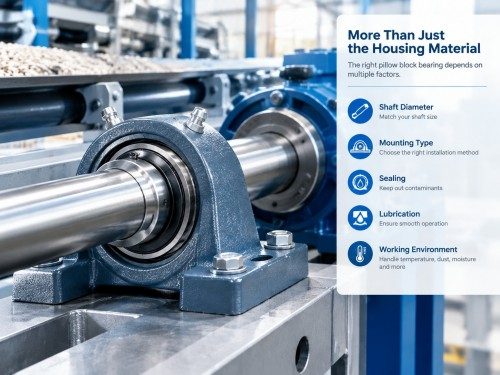
Once the housing material has been narrowed down, the next step is to verify that the complete bearing unit matches the mechanical and operating requirements.
1. Shaft Diameter and Mounting Dimensions
Check the shaft diameter, bore size, housing footprint, mounting-hole spacing, overall dimensions, and available installation clearance.
For replacement purchases, do not rely on the model number alone when the original manufacturer or specification is uncertain. Compare the actual dimensions and mounting arrangement before ordering.
2. Load, Speed, and Operating Conditions
Determine the radial and axial loads, operating speed, duty cycle, vibration, and potential impact loads.
The load capacity of a complete bearing unit depends on its internal bearing design, dimensions, housing construction, mounting arrangement, and other application factors. Housing material alone does not establish the unit's load rating.
Compare the manufacturer's technical data with the actual operating requirements and relevant service conditions.
3. Internal Bearing Design and Locking Method
Pillow block bearing units may differ in internal bearing design and shaft-locking arrangement. Depending on the product, the locking method may involve set screws, an eccentric locking collar, or another specified design.
Verify the insert, bore tolerance, locking method, and shaft fit. For replacements, confirm that the proposed unit matches the required dimensions and configuration.
Where applicable, review the bearing unit insert range to investigate compatible component options.
4. Seals and Lubrication
Seals help protect the bearing from contaminants and retain lubricant, but their effectiveness depends on the design and operating environment.
Consider dust, water exposure, cleaning chemicals, temperature, speed, and relubrication requirements. A corrosion-resistant housing cannot compensate for an unsuitable seal or lubricant.
Confirm the sealing arrangement and lubrication specification before selecting a bearing for demanding operating conditions.
Stainless Steel vs. Cast Iron Pillow Block Bearings by Application
These examples provide a starting point for material selection. The final choice should be based on the complete bearing unit and its verified specifications.
| Application | Material to Consider | Key Verification Points |
|---|---|---|
| Food-processing equipment | Stainless steel where required by the environment | Hygiene requirements, material grades, seals, lubricant, and cleaning conditions |
| Washdown packaging machinery | Stainless steel where compatible with the cleaning process | Chemical exposure, washdown method, sealing, and internal components |
| General industrial conveyors | Cast iron may be suitable | Load, alignment, mounting, dust, and corrosion protection |
| Agricultural machinery | Cast iron may be suitable in compatible conditions | Moisture, dust, impact, sealing, and maintenance |
| Equipment exposed to corrosive chemicals | A compatible stainless steel grade or another suitable material system | Chemical compatibility, temperature, concentration, and exposure duration |
| Existing equipment requiring replacement | A verified compatible bearing unit | Bore, dimensions, insert, locking method, seals, and mounting |
For aggressive chemicals, high-pressure cleaning, or strict hygiene requirements, obtain confirmation of material compatibility and the relevant product specifications before ordering.
How to Compare Total Cost of Ownership
The initial unit price is only one part of the purchasing decision. A useful comparison also considers installation, maintenance, replacement, and operational disruption.
Evaluate the following factors for each technically suitable option:
Purchase cost: Compare quotations for equivalent specifications, quantities, and supply conditions.
Maintenance requirements: Account for inspection, lubrication, cleaning, and any necessary corrosion protection.
Replacement and downtime: Consider access for replacement and the operational consequences of bearing failure.
Inventory and compatibility: For OEMs and distributors, consider replacement availability, model consistency, and the number of configurations that must be stocked.
Environmental suitability: Avoid choosing a lower-cost unit if its materials or seals are unsuitable for the operating conditions.
Stainless steel may justify a higher purchase price in some environments, while cast iron may be more economical in others. The objective is to select a bearing unit that meets the application requirements at an acceptable total cost.
What OEMs and Distributors Should Prepare Before Requesting a Quote
Once a suitable material and configuration have been identified, prepare the following information to help the supplier assess your requirements.
Part number: Provide the existing model number or required product reference, if available.
Dimensions: Confirm the shaft diameter, bore size, housing dimensions, and mounting-hole spacing.
Material requirements: Specify the preferred housing material and any environmental constraints.
Operating conditions: Describe the application, loads, speed, temperature, moisture, contaminants, and cleaning conditions.
Configuration: Identify the required insert, locking method, seals, and lubrication arrangement where known.
Order quantity: State the quantity needed for samples, initial production, replacement, or bulk purchasing.
Delivery destination: Provide the destination market and delivery requirements.
For OEM programs, also confirm drawing availability, specification control, inspection requirements, packaging, and repeat-order consistency where applicable.
Providing this information helps the supplier evaluate the request against available configurations rather than quoting on housing material alone.
Frequently Asked Questions
Are stainless steel pillow block bearings always better than cast iron?
No. Stainless steel may be preferable when corrosion resistance is important, but suitability depends on the material grade, environment, internal components, and sealing arrangement. Cast iron can be a practical and economical choice for many general industrial applications.
Are cast iron pillow block bearings suitable for wet environments?
They may be suitable in some moisture-prone environments when the housing protection, maintenance practices, and complete unit specifications are appropriate. Persistent moisture, corrosive substances, or frequent washdown may require a different material or protection strategy.
Does a stainless steel housing mean the entire bearing unit is stainless steel?
Not necessarily. The housing, internal bearing, rolling elements, seals, fasteners, and other components may use different materials. Confirm the specifications of the components relevant to your application.
Which pillow block bearing should I choose for an OEM project?
Start with the operating environment, shaft dimensions, loads, speed, mounting requirements, and maintenance conditions. Compare compatible bearing-unit configurations and confirm the material specifications with the supplier before approving the design.
Request a Pillow Block Bearing Quote
The right choice between stainless steel and cast iron pillow block bearings depends on the operating environment, mechanical requirements, and specifications of the complete bearing unit.
Yang Bearing can be contacted to discuss suitable configurations for OEM projects, replacement requirements, and distributor purchasing needs.
To help assess your requirements, provide the bearing model or dimensions, preferred housing material, application, quantity, and delivery destination. If the appropriate configuration is uncertain, include the operating conditions so available options can be evaluated against your requirements.
Explore Pillow Block Bearings or contact Yang Bearing through the website to discuss your requirements.